Advanced Techniques for Seamless PBR Fire Textures in 3D Workflows
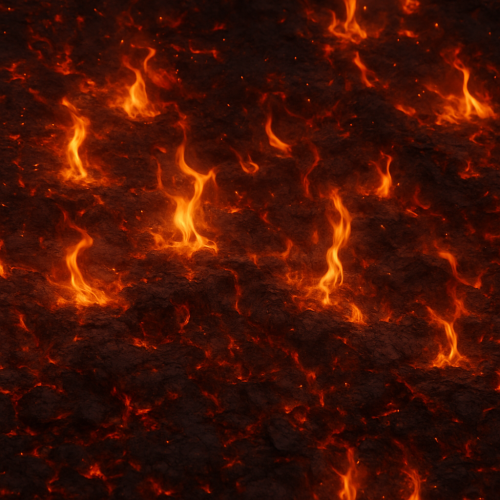
Capturing photorealistic fire textures for physically based rendering (PBR) workflows presents unique challenges, particularly when leveraging scanning and photogrammetry techniques traditionally reserved for static, solid surfaces. Fire itself, as a dynamic, ephemeral phenomenon, does not lend itself directly to conventional scanning methods. Instead, the focus must shift toward acquiring accurate textures of the residual effects of fire—burnt surfaces, charred materials, ash deposits, and heat-affected zones—as well as stable flame reference images for albedo and emissive texture creation. These assets, combined with procedural or shader-based solutions, enable a convincing representation of fire in real-time engines such as Unreal Engine or offline renderers like Blender’s Cycles.
The foundation of high-fidelity fire texture acquisition lies in the meticulous capture of fire-affected materials. Burnt wood, scorched metal, cracked paint, and soot-covered stone all exhibit distinct microvariations in roughness, normal detail, and ambient occlusion that are essential for realism in PBR workflows. To accurately capture these, high-resolution photogrammetry remains the gold standard. Employing a calibrated multi-camera rig or a single high-megapixel DSLR, preferably with a macro lens for detailed close-ups, allows for dense image sets that can be processed into detailed texture maps with software such as Agisoft Metashape or RealityCapture.
When preparing for photogrammetry, environmental considerations play a critical role. Outdoor conditions, where many fire-damaged materials are found, often introduce uncontrolled lighting variations that can compromise albedo fidelity and complicate the extraction of accurate roughness and normal maps. Using a portable, diffuse light setup or shooting under overcast skies helps achieve evenly lit captures with minimal shadows, crucial for isolating surface reflectance properties. Including a calibrated color checker in each shoot ensures consistent color grading and linear workflow adherence, which directly impacts the albedo/base color texture accuracy in the PBR pipeline.
One core difficulty in scanning burnt surfaces is balancing the need for high micro-detail with the inherently irregular and often fragile nature of fire damage. Cracked and peeling surfaces may shift or crumble between passes, introducing artifacts in the photogrammetry reconstruction. Stabilizing the subject, either by carefully mounting samples or selecting weathered but stable areas, mitigates these issues. Additionally, capturing multiple passes at varying angles and focal lengths enhances the normal and height map fidelity by providing comprehensive geometry coverage for dense point cloud generation and subsequent mesh baking.
For roughness and metallic channel extraction, traditional photogrammetry outputs require augmentation. Many burnt materials are non-metallic but exhibit complex variations in roughness due to soot accumulation, charring depth, and residual gloss from heat-affected resins or melted coatings. To capture this nuance, integrating cross-polarized photography techniques is beneficial. By photographing the surface both with and without polarized filters, you can isolate specular reflections from diffuse albedo, enabling the derivation of more accurate roughness maps through subtraction and thresholding in post-processing. Metallic maps are generally sparse in burnt materials but should be validated via spectral analysis or reference to material composition, especially for metals with oxidation or heat coloration.
Ambient occlusion (AO) maps derived from photogrammetry meshes are invaluable for enhancing shadowing in PBR shading models. However, raw baked AO often requires manual refinement to account for subtle soot deposits and surface porosity characteristic of fire damage. Combining baked AO with hand-painted or procedural masks, generated in tools like Substance Painter or Quixel Mixer, creates layered AO maps that respond dynamically to lighting and camera angles within rendering engines. This approach compensates for the partial occlusion effects caused by uneven char layers and ash residues that photogrammetry alone cannot resolve fully.
Normal and height maps are critical for conveying the tactile roughness and depth of fire-damaged surfaces. High-quality normal maps can be baked directly from the dense meshes generated during photogrammetry, but the ephemeral texture of burnt surfaces necessitates careful mesh cleanup and retopology. Overly noisy meshes can produce exaggerated or noisy normals, whereas insufficient detail flattens the surface response in engines. Employing mesh decimation combined with normal map baking at multiple resolutions allows for optimized texture sets that balance fidelity and runtime performance. Height maps derived from displacement or parallax occlusion mapping further enhance depth perception and can be fine-tuned in engine shaders to simulate the cracked and blistered appearance of fire damage without incurring heavy geometric costs.
Although direct scanning of flames is impractical, high-speed, high-resolution photography of flames against neutral backgrounds can provide valuable albedo and emissive texture references. These can be processed into animated texture sheets or flipbooks for use in particle systems within Unreal Engine or Blender’s shader nodes. Careful calibration of exposure and white balance is essential to preserve color accuracy and dynamic range, capturing the subtle gradients of orange, yellow, and blue hues inherent to combustion. Additionally, capturing flame silhouettes and volumetric light interaction aids in constructing physically plausible shaders that respond realistically to scene lighting and camera positioning.
Tiling and micro-variation are paramount concerns when authoring fire textures for large-scale environments or assets. Fire-damaged surfaces rarely exhibit uniform appearance; slight variations in char depth, ash distribution, and soot density create a natural randomness critical for realism. Photogrammetry-derived textures often require manual tiling adjustments to avoid visible repetition. Techniques such as texture blending, overlaying procedural noise, and utilizing stochastic tiling shaders in engines mitigate these artifacts. For example, Unreal Engine’s material editor supports world-space UVs and noise functions that can modulate roughness or emissive intensity to break up tiling patterns convincingly. Similarly, Blender’s node-based shader system permits layered texture mixing and vector displacement to simulate micro-variation dynamically.
Calibration and optimization are integral throughout the acquisition and authoring process. Ensuring linear workflow compliance from raw capture to final texture export maintains physical correctness in albedo and roughness responses. Utilizing calibrated color targets and exposure bracketing during photography enables HDR texture generation, which is particularly beneficial for emissive fire textures. Optimization for engine usage demands carefully sized texture maps, often balancing between 2K and 4K resolutions based on asset scale and camera proximity. Efficient mipmapping and texture compression settings further preserve performance without sacrificing visual fidelity in real-time applications.
Incorporating scan data into PBR workflows requires thoughtful integration. In Unreal Engine, textures derived from photogrammetry can be imported as standard texture assets, with roughness, normal, and AO maps assigned to respective material slots. Custom shaders incorporating emissive channels and dynamic opacity masks enhance the realism of fire-damaged surfaces, especially when combined with particle effects for active flames. In Blender, node groups can combine these textures with procedural noise and displacement modifiers to achieve similar results in both Eevee and Cycles renderers. Leveraging engine-specific features such as Unreal’s virtual texturing or Blender’s adaptive subdivision enables high-detail rendering of fire textures without excessive resource consumption.
Ultimately, the acquisition of photorealistic fire textures via scanning and photogrammetry hinges on adapting traditional surface capture methods to the idiosyncrasies of fire-affected materials. By focusing on stable remnants of combustion, utilizing controlled lighting and calibrated capture setups, and refining texture maps through advanced processing and shader authoring, artists and technical directors can produce highly believable fire textures that integrate seamlessly into PBR pipelines. These textures, when combined with procedural animation techniques and engine-specific optimizations, provide a robust foundation for rendering fire and its aftermath with striking photorealism.
Creating fire textures within a PBR framework presents a unique set of challenges that demand a careful balance between procedural generation and photographic acquisition to capture the complex interplay of flames, embers, smoke, and heat-affected surfaces. Fire is inherently dynamic and semi-transparent, its visual complexity arising not only from emissive qualities but from layered, evolving materials that interact with light and surrounding geometry. Consequently, the authoring of fire textures requires a workflow that supports both artistic flexibility and physical plausibility, ensuring textures can be effectively integrated into real-time engines such as Unreal Engine or offline renderers like Blender’s Cycles and Eevee.
Starting with procedural methods, the advantage lies in the capacity to generate infinite variations with controlled parameters, essential for avoiding obvious tiling artifacts and accommodating diverse fire intensities and color shifts. Procedural fire texture generation typically begins with noise and fractal functions that simulate the chaotic, turbulent nature of flames and embers. Perlin or Worley noise variants, layered and manipulated through gradient maps, can produce the base albedo patterns representing flame shapes and glowing embers. These maps should be carefully calibrated to reflect the typical color temperature gradients of fire—from deep reds and oranges near the base to yellows and near-white at the hottest tips—ensuring the albedo does not become oversaturated, which can break physical plausibility under PBR lighting.
Beyond albedo, roughness maps derived procedurally help simulate the interaction between heat-affected surfaces and the environment. For example, scorched wood or metal adjacent to flames tends to have a distinct roughness profile: smooth in melted or charred areas, rough in ash-covered regions. Procedural roughness can be generated by combining noise with masks representing soot accumulation or surface pitting, often driven by height or ambient occlusion data to reflect crevices where smoke deposits more heavily. Height maps are critical for this layering effect, as they enable the displacement or parallax occlusion necessary for convincing surface detail at runtime without excessive geometry cost.
Normal maps, while less directly relevant to the flames themselves, are indispensable for the surrounding surfaces affected by fire. Procedural authorship of normal maps can use noise-based height fields to simulate blistering or cracking of materials under thermal stress, which, when combined with ambient occlusion maps, enhance the perception of depth and realism. In some workflows, procedural normal map generation can be integrated with curvature maps derived from the height data, providing micro-variation essential for catching light subtly and breaking up the otherwise flat appearance of scorched surfaces.
When incorporating emissive elements, procedural textures often use animated masks or vertex displacement combined with alpha transparency to simulate flickering flames. While emissive maps are not standard PBR channels, their interplay with the base color and roughness is paramount; emissive intensity should be balanced so that it doesn’t overpower physically-based reflections but still convincingly simulates the light emission from fire. Procedural generation allows for dynamic control over these emissive parameters, crucial for effects like pulsing embers or flame flicker synchronized with environmental lighting.
On the photographic side, acquiring high-quality source imagery for fire textures is a delicate process. Fire’s transient nature and high contrast between bright flames and dark surroundings pose challenges in exposure and color calibration. Photographs should be captured with high dynamic range methods where possible, or bracketed shots merged in post to preserve detail in both hot spots and shadowed areas. The albedo textures extracted from photographic sources require meticulous color correction to remove baked-in lighting and ensure they are suitable for PBR workflows. This often involves neutralizing color casts from ambient lighting and isolating the flame colors from background elements, which can be achieved through selective masking and channel manipulation in image editing software.
Roughness and specular properties are rarely directly captured in fire photographs, so these maps must be authoritatively derived by analyzing the thermal and material context of the image. For example, soot-covered surfaces tend to be matte with high roughness, whereas molten metal near flames exhibits low roughness and high specularity. Creating these maps from photos often involves hand-painting or procedural synthesis guided by the albedo and height data. Photogrammetry is generally impractical for fire itself, but for scorched surfaces, it can be invaluable in capturing accurate geometry and texture detail, which can then be baked into normal and AO maps.
Ambient occlusion maps derived from photographic sources are often generated through baking processes on the underlying geometry, but when working purely in texture space, AO can be approximated using curvature and height data extracted from high-resolution photo textures. This enhances the depth cues in the fire-affected materials, especially in crevices where ash or soot accumulates. Height maps, crucial for displacement effects, can be created by applying edge-detection filters and grayscale conversion techniques on the photo textures, then refined through manual editing to remove noise and ensure physical plausibility.
In practice, the most versatile fire texture sets combine procedural and photographic techniques. For example, a base albedo map may be photo-derived from a controlled flame capture, while roughness, height, and normal maps are procedurally generated or enhanced to add micro-variations and dynamic detail. This hybrid approach allows artists to leverage the realism of photography while retaining the flexibility of procedural modification for tiling, scaling, and animation. It also facilitates optimization: procedural elements can be adjusted on the fly in shaders or material instances within Unreal Engine or Blender, reducing the need for multiple texture variants and lowering memory usage.
Tiling and micro-variation are critical considerations in fire texture authoring. Pure photographic textures often contain repetitive patterns that are visually disruptive when tiled. To mitigate this, procedural noise can be blended with photo textures in layered shaders to introduce subtle variations in color, roughness, and displacement. Additionally, texture sets can be authored with multiple LODs, where distant fire surfaces rely on simplified procedural textures with lower resolution, while close-ups reveal detailed photo-based albedo and normal maps. This ensures real-time performance without sacrificing fidelity where it matters most.
Calibration against engine lighting is another essential step. Fire textures should be tested under a variety of lighting conditions and tone-mapping settings to ensure the emissive and albedo colors maintain their intended appearance. In Unreal Engine, for example, the use of physically-based shading models and HDR lighting requires the emissive intensity to be carefully balanced so that bloom and light scattering effects enhance rather than overwhelm the texture’s realism. Likewise, Blender’s Eevee renderer, which uses screen-space reflections and ambient occlusion, demands that roughness and AO maps be finely tuned to avoid flat or overly harsh shading.
Optimization strategies often involve packing multiple grayscale maps—roughness, AO, height—into different channels of a single texture to reduce draw calls and memory footprint. For fire textures, this means ensuring these maps share compatible resolutions and UV layouts. When animating flames or embers, procedural shader techniques can modulate these maps dynamically, for instance, by shifting noise patterns or blending between different texture sets to simulate flickering and movement without resorting to expensive animated textures.
Ultimately, the creation of fire textures in a PBR context is a multidisciplinary process that leverages the strengths of both procedural generation and photographic capture. By carefully authoring base color, roughness, normal, AO, and height maps with attention to physical accuracy, micro-variation, and engine-specific shading models, artists can produce versatile, reusable texture sets. These textures not only embody the chaotic beauty of fire but also behave predictably under physically-based lighting, enabling immersive and performant visual effects across a range of digital content pipelines.
Creating a comprehensive set of Physically Based Rendering (PBR) maps for fire materials requires a nuanced approach, as fire is inherently a dynamic, emissive phenomenon that challenges traditional surface-based texturing paradigms. While fire itself is volumetric and transient, in many real-time and offline rendering contexts—such as particle systems, volumetric shaders, or billboards—artists rely on 2D or 3D textures mapped onto geometry or particles to simulate its appearance. To convincingly capture fire’s complex visual properties through PBR maps, the artist must carefully consider how each map contributes to the perception of heat, glow, and surface interaction, even when the “surface” is an abstracted plane or volume proxy.
The BaseColor (albedo) map for fire materials is arguably the most critical, as it encodes the color information that defines the characteristic gradients and hues—ranging from deep reds and oranges to bright yellows and near-white core areas. Unlike opaque surfaces, fire’s coloration is not uniform or static; it fluctuates spatially and temporally, with color transitions driven by temperature variations and combustion chemistry. When authoring BaseColor textures, it is essential to capture these gradients with high dynamic range (HDR) data or through emissive layering in the shader, since fire emits light rather than reflecting it. If working within Unreal Engine or Blender’s shader systems, the BaseColor map often acts as a mask or a base for emissive maps rather than a pure reflectance input. Consequently, artists frequently create layered albedo maps that combine subtle color shifts with emissive intensity maps, ensuring the fire glows realistically when rendered.
The Normal map in fire materials serves a somewhat unconventional role. Since fire does not possess a fixed geometric surface, the Normal map is often used to simulate the illusion of turbulent surface detail on the proxy geometry or particle cards, adding micro-variations that break up visual uniformity and enhance the perception of chaotic motion. Procedural noise or fluid-sim-derived normal maps are commonly employed, capturing swirling patterns and small-scale eddies that convey the fire’s dynamic nature. These Normal maps must be carefully calibrated to avoid introducing hard surface artifacts; subtlety is key, as overly strong normals can contradict the expected softness of flames. Tiling patterns for Normal maps should be chosen with attention to scale, ensuring that noise patterns match the size of flame elements and avoid obvious repetition. In Blender’s node-based workflows or Unreal’s material editor, blending multiple noise layers can achieve a more organic, non-repetitive normal effect.
Roughness maps for fire materials control how sharply light interacts with the surface, but since fire is emissive and mostly self-illuminated, roughness influences the interaction between the flame’s surface and external light sources, such as environmental reflections or cast light from nearby geometry. Typically, roughness values are low to medium, simulating a semi-glossy, flickering surface that reflects highlights dynamically. However, roughness variation can also represent localized soot deposits, burning debris, or partially cooled flame edges. These micro-variations enhance realism by indicating differential combustion states and surface damage. When authoring Roughness maps, it is effective to generate them procedurally from the same noise patterns driving normals, with softened contrasts to avoid harsh transitions. Calibration against a physically accurate reference or in-engine preview is critical to ensure that roughness values do not flatten the fire’s appearance or create unnatural specular highlights.
Metallic maps are generally less applicable to pure fire materials, as fire itself lacks metal content and does not exhibit metallic reflectance. In standard PBR workflows, the metallic channel is often set to zero or ignored for flames. However, if the fire texture includes burning metal surfaces, embers, or slag, a metallic map may be employed to localize metallic reflections on those elements. This is rare and situational but can enhance the perceived interaction between fire and surrounding materials in a scene. In such cases, metallic maps should be sharply defined, matching the emissive and roughness maps to maintain consistency.
Ambient Occlusion (AO) maps are somewhat counterintuitive for fire, given its emissive and volumetric nature, but they still play a subtle role in defining how ambient light interacts with the geometry or particle proxies. AO maps can simulate the self-shadowing of denser flame regions, smoke billows, or charred surfaces adjacent to the fire. When authoring AO maps for fire materials, artists often start with grayscale masks derived from volumetric density or opacity textures, emphasizing the occlusion of light in thick or concentrated flame clusters. AO can also be used as a mask to modulate emissive intensity, darkening areas where flames are less active or obscured. In real-time engines like Unreal, combining AO with subsurface scattering or volumetric fog shaders can produce more believable layering effects around fire sources.
Height or Displacement maps for fire materials present unique challenges because flames do not have a static height structure. Instead, height maps can be used to simulate surface irregularities on proxy geometry or to drive vertex displacement for particle cards, giving the illusion of flickering flame tongues and dynamic contours. Height maps are usually derived from procedural noise or fluid simulation data, capturing vertical gradients and sharp peaks corresponding to hotter flame regions. Proper tiling and scaling are essential to prevent noticeable repetition or unnatural flattening. In Blender’s displacement workflows, height maps can be combined with animated noise textures to produce temporal variation, enhancing the illusion of movement. Unreal Engine’s tessellation and displacement features can also utilize these maps to add depth without heavy geometry costs, though performance considerations must guide optimization.
Tiling and micro-variation across all PBR maps are critical for fire materials because repeated patterns are particularly noticeable and break the illusion of organic, chaotic flames. Artists often employ large, high-resolution textures combined with procedural noise overlays to introduce subtle variations at multiple scales. Techniques such as triplanar projection can alleviate UV stretching and seams on complex proxy geometry or particle systems. Additionally, blending multiple noise layers with varying frequencies and amplitudes helps simulate the turbulent behavior of fire. Calibration of these maps should always be done in context, using engine-specific preview tools to verify how each map interacts under dynamic lighting and emissive conditions. For instance, Unreal Engine’s material editor allows real-time tweaking of emissive intensity, roughness, and normal strength, enabling rapid iteration.
Optimization remains a key concern when authoring fire PBR maps. Given that fire materials are often used in real-time contexts with multiple instances—such as particle systems or volumetric effects—texture sizes should balance fidelity with memory constraints. Using grayscale maps for roughness, AO, and height can save channels in packed textures, and employing mipmapping with bias adjustments ensures that distant flames do not consume excessive resources. Where possible, procedural generation of maps at runtime can further reduce texture memory usage and introduce infinite variation, although at a computational cost. Artists should also consider using emissive masks and color ramps within the shader to reduce the number of textures required, consolidating multiple effects into fewer texture lookups.
In engine usage, fire materials benefit greatly from integrated emissive workflows coupled with post-processing effects such as bloom and volumetric lighting. In Unreal Engine, combining the emissive channel with dynamic light sources and particle systems can produce convincing flame glows and heat distortions, supported by the PBR maps authored as described. Blender’s shader nodes enable granular control over emission strength, subsurface scattering, and displacement, allowing artists to iterate on appearance with immediate feedback. Both engines support layering of animated textures or flow maps, which, when paired with carefully crafted PBR maps, elevate the realism of fire effects.
In summary, creating a full suite of PBR maps for fire materials involves treating the flame not as a conventional opaque surface but as an emissive, semi-transparent, and highly dynamic entity. Each map—BaseColor, Normal, Roughness, Ambient Occlusion, Height/Displacement, and occasionally Metallic—must be authored with an understanding of fire’s physical and visual complexity. Through careful calibration, procedural micro-variation, and engine-specific optimization, these maps collectively enable realistic rendering of fire that convincingly conveys heat, glow, and surface interaction within both real-time and offline workflows.
FAQ
What is covered in this guide?
This guide explains Advanced Techniques for Seamless PBR Fire Textures in 3D Workflows with practical notes for seamless PBR materials, texture setup, and production use.
Can I use these texture techniques in Blender, Unreal Engine, and Unity?
Yes. The workflow focuses on standard PBR maps and tileable materials that can be used in Blender, Unreal Engine, Unity, archviz, games, and VFX pipelines.
Where can I find textures for this workflow?
Use the AITextured texture library and the related texture links on this page to find seamless PBR materials and preview them before download.
Related Textures
 Procedural Dark Tree Bark PBR Texture
 Procedural Aged Oak Plank PBR Texture
 Seamless PBR Wood Planks Texture Featuring Natural Grain in 4K
 Seamless Wooden Facade PBR Texture in 4K Resolution
 Rustic Aged Wood Planks Texture for 3D Modeling and Rendering
 PBR Texture of Vertical Wooden Planks Wall
 Seamless PBR Wood Texture Featuring Vertical Natural Grain Patterns
 Natural Wood Logs Texture with Snow for 3D PBR